May 9, Europe Day: A Story of Coal, Steel, and Unity – Celebrating the Birth of the European Dream
Europe Day on May 9 celebrates the 1950 Schuman Declaration, which laid the foundation for European unity. This historic moment marked the transformation of a war-torn continent into a symbol of peace and cooperation. Explore the journey from coal and steel sharing to the creation of the European Union, and how Europe continues to build on this legacy of unity and shared progress.
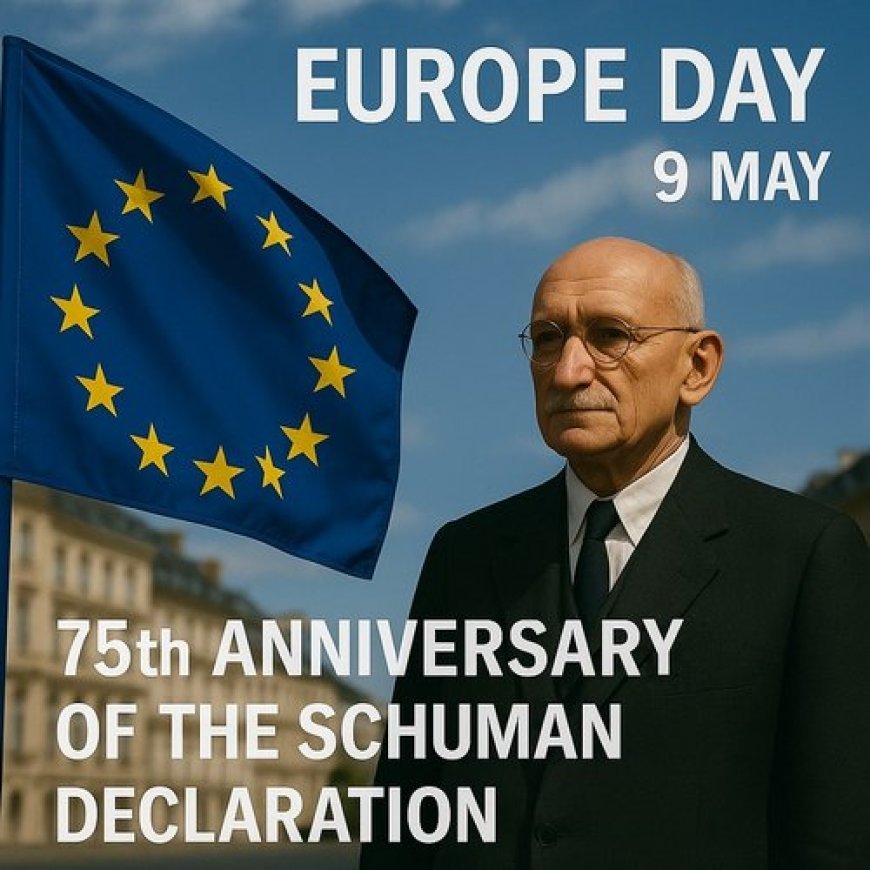
Europe Day: A Whirlwind Tale of Pacts, Peace and Panache
Once upon a May 9th, long after two world wars had left Europe in pieces, a brave French minister named Robert Schuman stood up and said, “Let’s share our coal and steel instead of fighting over them!” That 1950 speech sparked what we now celebrate as Europe Day – a yearly reminder of how once-warring countries hugged it out for good (and occasionally argued over waffle versus panini preferences). Europe Day on May 9th celebrates peace and unity, marking Schuman’s 9 May 1950 “Declaration” that proposed pooling coal and steel production. (Oddly enough, the Council of Europe – a different group founded in 1949 – still celebrates Europe Day on May 5th, since it was founded on 5 May 1949.)
A Ruined Continent Gets an Idea
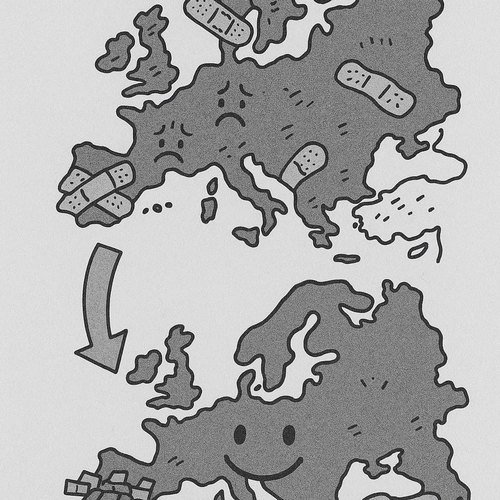
Before Europe Day, Europe had two colossal tantrums (World Wars) that left cities flattened and people exhausted. Imagine Europe in 1945: smokestacks silent, towns in rubble, and children sharing whispered stories of “the day the boom-booms ended.” Leaders knew better than to let history repeat itself. Even Winston Churchill famously urged in 1946, “We must build a kind of United States of Europe” – a mega-fortress of unity that would keep the peace. By 1949, Europeans had founded the Council of Europe (for human rights and democracy), which celebrated its own Europe Day every 5 May (because – true story – it was founded on 5 May 1949). But the big European family needed an actual treaty union to really stick together.
Schuman’s Declaration: Coal, Steel and “Not Again!”
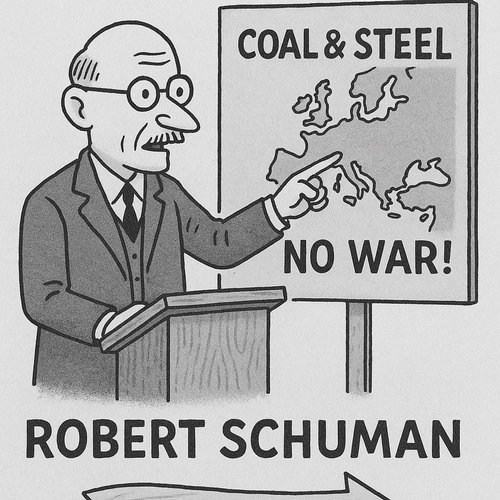
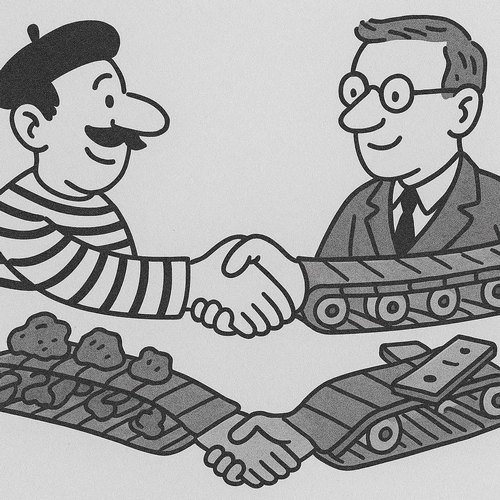
Enter Robert Schuman, a gentle, monkish-seeming French statesman (he even lived simply like a cleric). On 9 May 1950, he unveiled a daring plan: France, Germany, Italy and the Benelux countries would pool their coal and steel industries so that war would become “not merely unthinkable, but materially impossible”. Think of it as the ultimate sharing app for heavy industry. Schuman’s idea – drafted with the help of behind-the-scenes whiz Jean Monnet (France’s “Father of Europe”) – led to the European Coal and Steel Community (ECSC) in 1951. Six countries signed on: France, West Germany, Italy, Belgium, the Netherlands and Luxembourg. By locking arms (and blast furnaces), these old rivals agreed: if our coal and steel are shared, we’d have zero interest in war.
Heroes of the Story: Monnet, Schuman and Friends
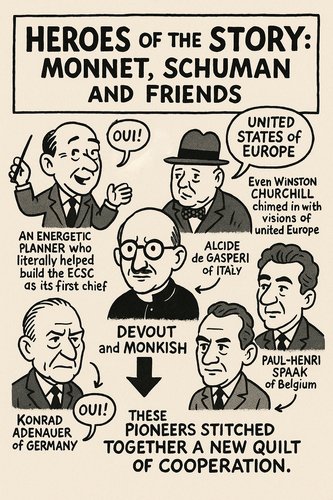
This wasn’t a one-man show. Jean Monnet, an energetic planner who once quipped that “Europe will be built through concrete achievements”, literally helped build the ECSC as its first chief. Monnet never held elective office but worked behind the scenes like an orchestra conductor – even though his only real applause line was “oui!” in multiple languages. (He was such a big deal he was later honored as the first Honorary Citizen of Europe in 1976.) Robert Schuman himself was twice Prime Minister of France and a Foreign Minister – a devout Catholic so ascetic that his daily life was called “monkish”. Legend has it he avoided luxuries, perhaps because he was saving all his cupholders for eventual EU officials’ coffee cups.
Other pioneers included Konrad Adenauer of Germany, Alcide de Gasperi of Italy and Paul-Henri Spaak of Belgium. Even Winston Churchill (British, not EU) chimed in with visions of united Europe. Churchill’s 1946 speech in Switzerland urged a kind of “United States of Europe,” saying Europe should “arise” from its ruins. (Britain never actually joined the EU project, but it at least sent postcards of encouragement.) The ambitious early Europeans all had quirks: Schuman was born in Luxembourg when Alsace-Lorraine was German territory (so he had more passports than a jet-setting spy), and Monnet was from a cognac-trading family (so maybe he believed in teamwork as one trusts in teamwork… somewhat like making brandy). Regardless, these pioneers stitched together a new quilt of cooperation.
Fast-Forward Timeline (Europe Grows Up)
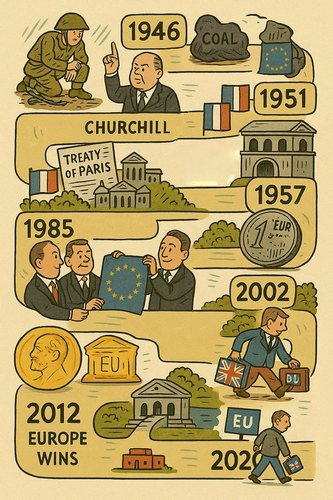
To keep track of all this, here’s a whirlwind timeline of key events from Schuman’s speech to today:
- 1945: WWII ends – Europe is exhausted but determined not to go through that again.
- 1946: Churchill’s “United States of Europe” speech plants seeds for unity.
- 1949: Council of Europe founded on May 5 (hence its Europe Day).
- 1950, May 9: Schuman’s Declaration proposes pooling coal & steel. This date becomes Europe Day!
- 1951: Treaty of Paris creates the ECSC (France, Germany, Italy, Benelux).
- 1957: Treaty of Rome launches the European Economic Community (EEC) and Euratom (more sharing!).
- 1985: EU leaders in Milan officially adopt May 9 as Europe Day and unveil the EU flag of 12 gold stars.
- 1992: Maastricht Treaty forms the European Union (EU) and EU citizenship.
- 2002: The euro currency enters people’s pockets (small change in some, huge change in unity!).
- 2012: Europe wins the Nobel Peace Prize for its role in keeping the peace.
- 2020: The United Kingdom exits the EU (Brexit) on 31 January 2020. Today the EU has 27 countries and still works on unity.
Europe Day Today: Flag-Waving Fun
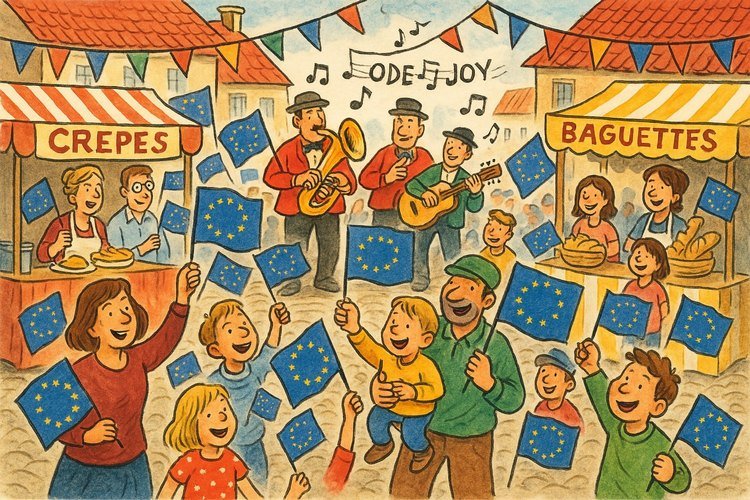
Fast-forward to now, and Europe Day is celebrated with pride (and sometimes cake). Every May 9th, EU institutions (Brussels, Strasbourg and beyond) hold open-door days so anyone can peek inside and see the flag, anthem and bustling bureaucracy. Kids run European quiz contests, bands play Beethoven’s “Ode to Joy” (the EU anthem), and TVs broadcast speeches. The EU’s symbols – the blue flag with 12 gold stars, the motto “United in diversity” (adopted in 2000) – all get a moment in the sun (or rain, depending on Brussels weather). In 2019 Luxembourg even made May 9 an official holiday every year. (By contrast, on May 5 the Council of Europe’s simpler Europe Day involves raising a flag and perhaps a debate on protecting some medieval parchment – it’s a slightly quieter sibling celebration.)
Outside bureaucratic circles, people mark Europe Day in smaller ways too. Schoolchildren might dress up as famous Europeans, or teenagers hold “Eurovision dinner” nights with foods from every EU country. Some cities host cultural festivals: in Warsaw there’s a “Schuman Parade,” in Germany “Europe Week,” and in Brussels an outdoor concert. And fun fact: in Ukraine since 2023 they decided to honor May 9 as Europe Day (instead of the Soviet-era Victory Day) to show how Ukraine feels European. So now on the calendar 9 May wears two hats depending on where you stand!
Pros (Hooray!) and Cons (Oy vey!) of Europe’s Big Hug
Let’s be honest: sticking so many countries together isn’t all sunshine and chocolates. But mostly it’s good stuff. Here are some major perks of EU unity:
- Peace: Since the EU’s start, none of its members have gone to war with each other. (For context: every European war prior to 1945 was really big and messy. EU leaders like to brag that Europe has been so peaceful that even the Nobel Committee noticed in 2012.)
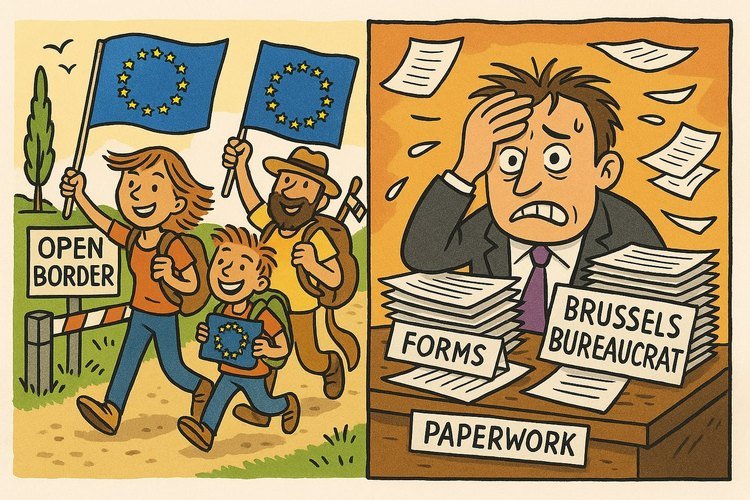
- Free travel & trade: The EU is one giant passport-free zone (thanks to the Schengen Area) and single market. Any EU citizen can live, work, study or retire in any member country. You can drive from Spain to Germany without a border guard ever asking your shoe size. Goods and money flow freely across borders with no tariffs, so shopping has more variety and often lower prices (hello, cheaper French wine!).
- Bigger voice: Alone you’re small potatoes on the world stage; together, you’re a veggie stew. The EU negotiates as a bloc on trade and climate agreements (and tries to lead on green policies). It has the world’s largest trading bloc, which gives it sway.
- Human rights and standards: The EU maintains common rules on the environment, workers’ rights, food safety, data privacy and more. In theory, that means minimum standards are high and we all get fair treatment. It’s also why there are strange rules like “bananas must be bendy” (yes, really – it’s about uniform shape for trade, but in practice it gets joked about).
- Cultural mash-up: There are 24 official languages, dozens of cultures, and yet one European identity. The official motto “United in diversity” (displayed in every language) says that EU citizens can be both proudly French and European, or proudly Romanian and European, etc. Programs like Erasmus let students jump countries for college, turning Europe into one big classroom.
But wait, there are trade-offs too:
- Sovereignty yawn: Countries have agreed to follow many EU rules and laws. Sometimes voters grumble that “Brussels is bossing us around.” For instance, adopting the euro meant giving up national currency control (which caused headaches during the 2008–12 debt crisis). When a few governments decide one thing (say, building a fast train), the EU’s 27 members can take forever to agree on funding or regulations.
- Bureaucracy headache: The EU has so many committees, commissions and acronyms that it makes a paperwork lover dizzy. Critics call it “the Brussels bubble.” (On the bright side, this means meeting rooms are never short on pastries!)
- Divided opinions: Not all Europeans always get along. Some want tighter union; others want less. Populist parties sometimes blame the EU for local problems. A famous example is the 2016 referendum where the UK voted to leave the EU. Brexit showed that unity isn’t guaranteed forever.
- Weird complexities: Ever try saying “hello” in 24 languages? Or making a football team of 27 different national teams? Schengen makes travel easy… unless a few countries briefly reintroduce border checks when something serious happens (migrant surges, pandemics, you name it). And some citizens just don’t feel “European” and care more about their hometowns.
Surprise Facts (Bet You Didn’t Know…)
Ready for some trivia? Here are a few fun nuggets about Europe Day and the EU:
- Double Holiday: 9 May is also celebrated by Russia and some Eastern countries as “Victory Day” (commemorating WWII’s end) because Germany signed surrender late on 8 May 1945, which was already 9 May in Moscow. So for Russians it’s about defeating the Nazis, while for EU folk it’s about preventing future wars. (Same date, different vibes.)
- Festive Flag: The EU’s blue flag with 12 stars (representing unity, completeness and perfection) first flew in 1955 and was officially endorsed along with Europe Day in 1985. You’ll see that circle of stars at Europe Day events everywhere.
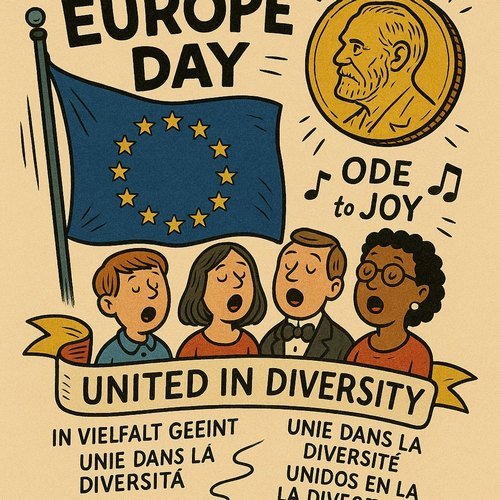
- Anthem and Motto: The EU’s “anthem” is the symphonic chorus from Beethoven’s 9th (Ode to Joy) – it’s played at ceremonies (no lyrics, just the tune). The motto “United in diversity” was adopted in 2000 to capture Europe’s goal: many cultures, one union.
- Nobel Peace Prize: In 2012 the whole EU got a Nobel Prize for spreading peace and stability. Apparently teamwork impresses the Nobel Committee.
- Languages Galore: With 27 members there are 24 official EU languages. Yes, every document and meeting gets translated. Europe’s institutions have more interpreters than a sci-fi conference.
- Growth Spurt: The EU started with 6 countries in 1951 and kept growing. It now has 27 (after the UK left in 2020). Countries like Norway, Switzerland and Iceland cooperate with the EU but (so far) remain outside. Meanwhile, hopefuls like Ukraine, Serbia and others are lining up if they meet the criteria.
- No Fighting Allowed: According to the EU itself, one big goal is “there is peace in Europe”. And indeed, ever since 1949 there’s been no war between EU members – a first in the continent’s history of squabbling kings and generals.
Europe’s Crystal Ball: Where to Next?
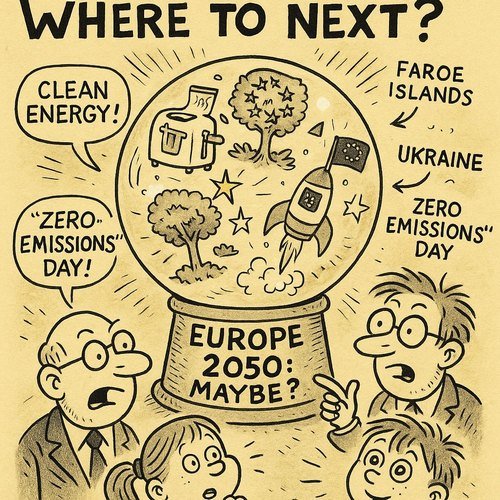
What does the future hold for our star-spangled continent? Well, projections for 2050 suggest Europe aims to be the first climate-neutral continent. In plain terms, the EU wants zero net greenhouse emissions by 2050 – talk about clean energy! The Green Deal is all about cutting carbon, planting trees and inventing solar-powered toasters. Perhaps Europe’s next big festival will be celebrating “zero emissions” day.
Politically, the EU may keep warming up its membership. Nations like Ukraine, Western Balkan countries or even tiny microstates (Gibraltar? Faroe Islands?) have looked starry-eyed at Brussels. Or maybe the EU gets more “digital” – imagine an EU space agency putting a flag on the moon, or a single vaccine passport used planet-wide. (Just kidding… or are we?)
One thing’s for sure: whether it’s solving global tech issues or arguing over roasted chestnut standards, Europe will continue its grand experiment. Today’s children might joke that “once upon a time, people were in different countries and didn’t Zoom each other!” The serious answer is that Europe's future could see deeper cooperation (fiscal union? unified foreign policy?) or bumps from nationalism – it’s the ultimate choose-your-own-adventure.
As one of Schuman’s quotes went: “Europe will be built through concrete achievements”. The concrete is still wet on our continent’s foundations, so buckle up (and learn some basic Romanian just in case)!
Celebrating May 9th (With Cake?)
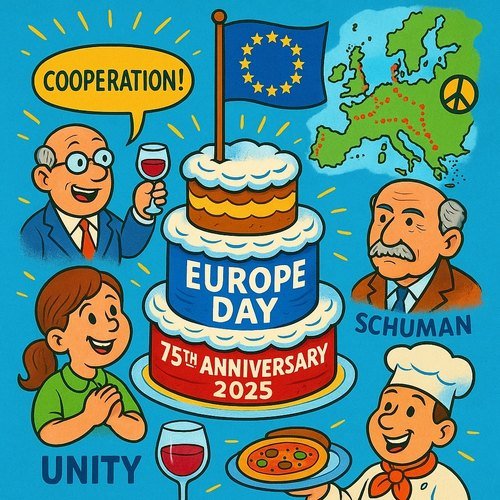
So why does all this matter today? Because Europe Day isn’t just history, it’s a reminder that cooperation works even for very different nations. On May 9, 2025 – the 75th anniversary of Schuman’s speech – Europeans are especially keen to party. Schools might hold mini-Parliaments, museums run EU-history scavenger hunts, and Brussels shows off its “open day” charm (people wandering the marble halls of the Parliament pretending to understand EU acronyms). Restaurants might offer EU-themed menus (maybe an Euro dog – a bratwurst wrapped in a crepe?).
Whether you’re 9 or 90, Europe Day is a good excuse to ponder: What if Europe had stayed fighting? Thankfully, after 1945 leaders chose sharing coal over fighting. The result has been an uneasy but mostly happy peace for millions. Europe Day on May 9 reminds us to celebrate that vision. So raise a (non-alcoholic) toast to peace, unity, and the next big European pizza cross-border oven exchange program!
Citations:
- Schuman Declaration May 1950 | European Union
- Europe Day – May 9 | European Union
- Europe Day - Wikipedia
- United States of Europe - International Churchill Society
- Robert Schuman - Wikipedia
- Jean Monnet - Wikipedia
- Easy to read – about the EU | European Union
- EU motto | European Union
- Achievements and benefits | European Union
- Victory Day (9 May) - Wikipedia
- 2050 long-term strategy - European Commission
What's Your Reaction?
 Like
0
Like
0
 Dislike
0
Dislike
0
 Love
0
Love
0
 Funny
0
Funny
0
 Angry
0
Angry
0
 Sad
0
Sad
0
 Wow
0
Wow
0