










Space-Based Solar Power: The Energy Future Beyond Earth
An exploration of space-based solar power (SBSP) as a clean, continuous, and global energy source. From orbital satellite technology to immense solar potential and engineering challenges, this project examines a scientifically grounded path to the planet’s energy future.

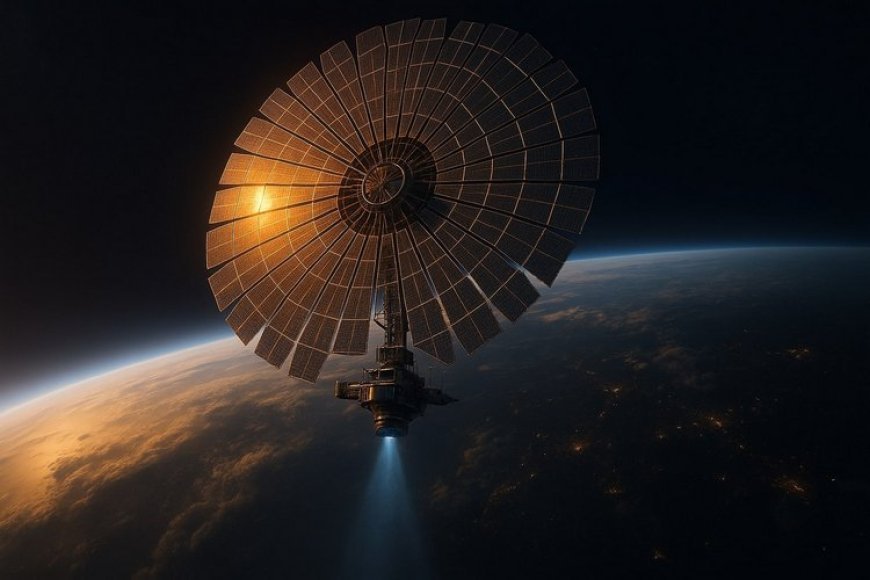
Space-Based Solar Power (SBSP) – The Road to a New Energy Era Beyond the Limits of Earth
Currently, global energy demand is increasing, while conventional Earth-based resources (fossil fuels, surface area for solar panels) are limited. The Sun provides virtually unlimited energy: in just one hour, the sunlight reaching Earth could cover the world’s annual energy consumption. In practice, however, ground-based solar panels only operate during the day and depend on weather conditions. Space-Based Solar Power (SBSP) proposes collecting solar energy directly in orbit and transmitting it to Earth, ensuring continuous, 24/7 power supply—regardless of weather or the day/night cycle.
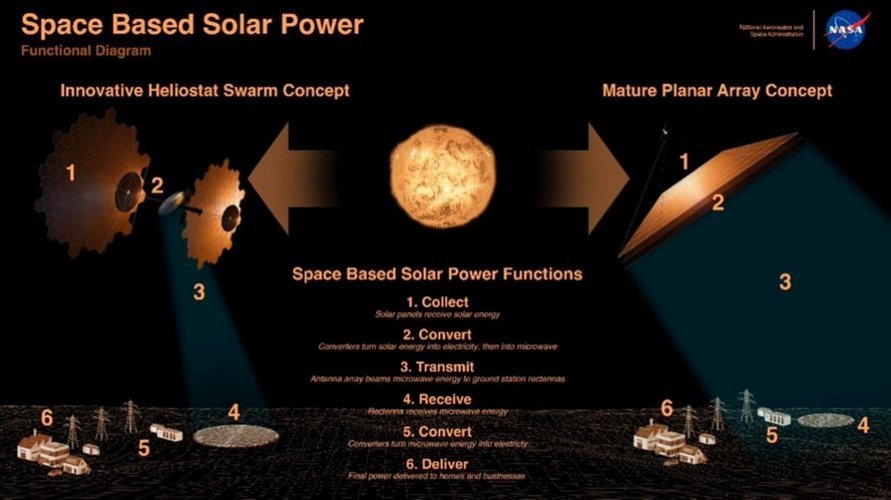 Continuous Solar Collection: SBSP satellites operate 24/7 with no impact on the ground.
How the Space Technology Works
The SBSP concept involves massive satellites placed in geostationary orbit. These satellites collect sunlight and convert it into radio signals (microwaves) using specialized photovoltaic modules. They then transmit concentrated microwave beams down to Earth, where a network of receiving antennas (rectennas) captures them. On the ground, the rectenna receives the microwave beam and reconverts it into usable electric power. Through this chain—space-based collection + wireless transmission + ground reconversion—large amounts of energy can be delivered to remote areas or directly into the national power grid. Although the technology is still in an experimental phase, concepts like the “sandwich panels” proposed by AFRL suggest that this approach is achievable in the near future.
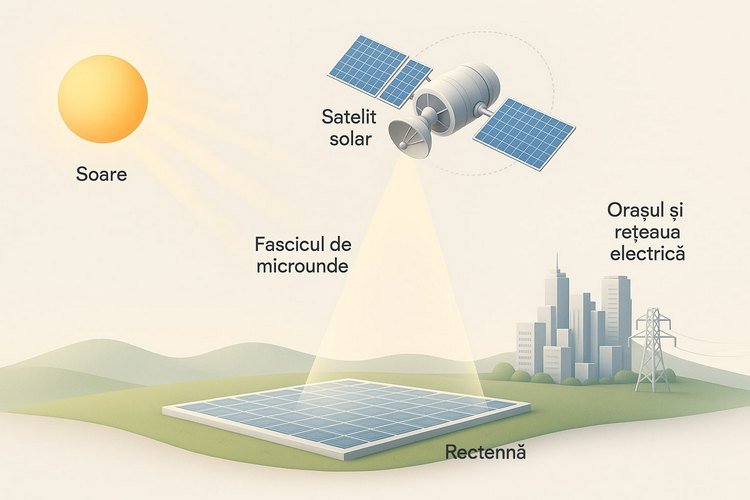 Full Flow: Sun → Satellite → Microwaves → Rectenna → Power Grid
Key Advantages
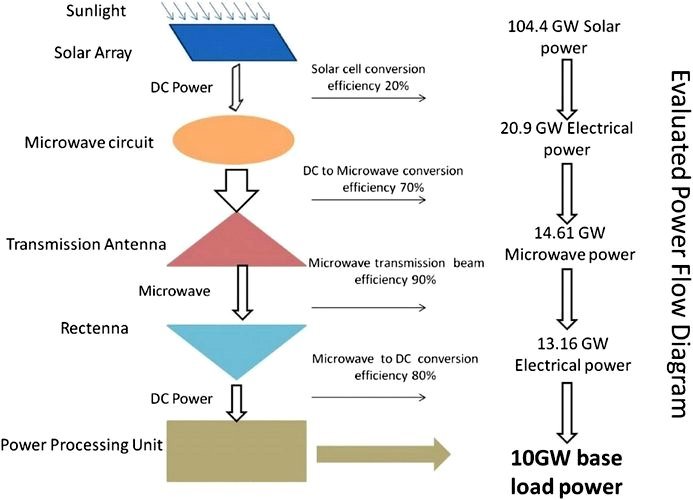 Space Solar Power Conversion: Power Flow and Stage-by-Stage Efficiency
A real-world example is the International Space Station: its solar panels (262,400 photovoltaic cells over ~2,500 m²) generate 84–120 kW—enough to power dozens of homes. This demonstrates the potential of large-scale photovoltaic systems in space. The advantages of SBSP include:
- Continuous and Uninterrupted Energy: Unlike ground-based solar panels, SBSP could provide baseload power—a stable and constant energy supply essential for the operation of national electrical systems—since satellites remain continuously exposed to sunlight. This allows power grids to be supplied without the fluctuations caused by day/night cycles or cloud cover.
- Abundant Resources: The amount of solar energy available in space is virtually unlimited. The Sun continuously radiates about 170,000 TW toward Earth, and even 1,000 SBSP satellites generating 2 GW each would add only ~0.001% to that radiation. Therefore, SBSP harnesses a colossal resource (the Sun) with minimal impact, tapping into only a tiny fraction of its vast solar potential.
- Complement to Earth-Based Sources: Space-based energy does not compete with terrestrial solar panels—it complements them. Since it is uninterrupted, SBSP energy is similar to nuclear or hydro power (stable and predictable). SBSP satellites can supply electricity to remote areas or operate in parallel with ground-based solar farms, maximizing the use of land already dedicated to energy production.
- Carbon Emissions Reduction: SBSP would help replace coal and oil power plants. Adding space-based energy has a negligible thermal effect (only about 0.001% of natural solar radiation), but the real benefit lies in reducing CO₂ emissions by substituting fossil fuels. In this way, the technology supports global climate goals.
- Powering Remote Areas: A practical advantage is the easy access to regions that are hard to connect to the grid. NASA highlights that SBSP can supply power to remote locations, complementing ground infrastructure—essentially enabling energy transmission to places where building power lines would be difficult or expensive.
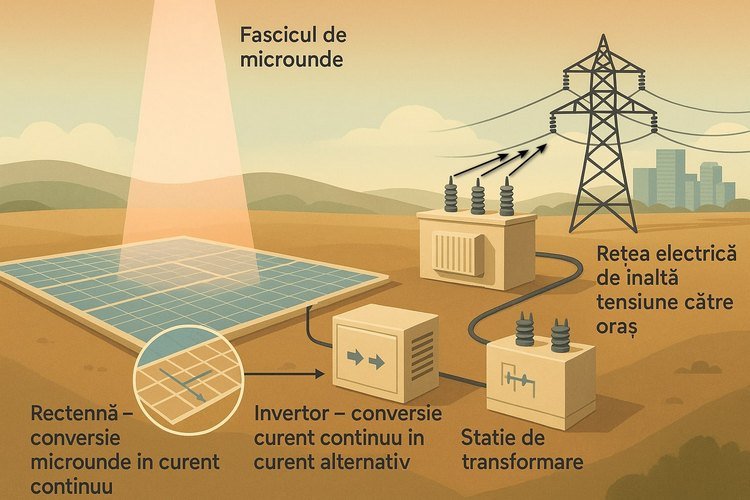 Step-by-Step Efficiency: Solar Collection → Microwave Conversion → Ground Reception → Grid Integration
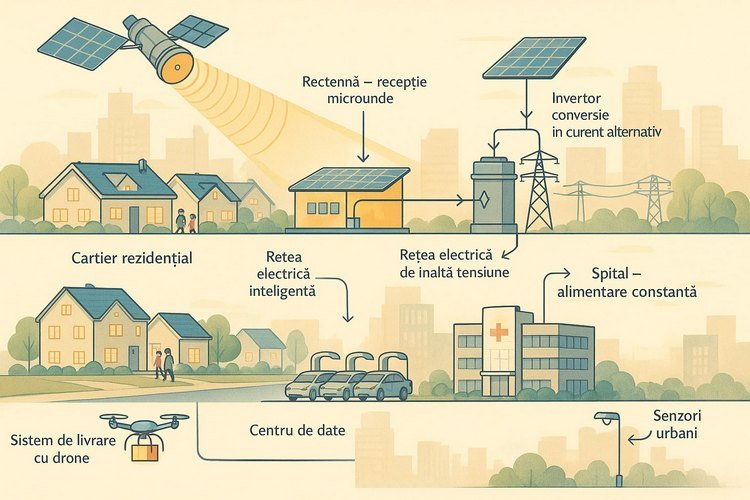 Specific Urban Applications of Wireless Energy Transmitted from Space — What Happens After the Energy Reaches the City
Challenges and Risks
- High Costs and Logistics: Building and launching massive satellites requires substantial investments. Recent NASA studies indicate that, at the current stage, SBSP would be more expensive than alternative Earth-based sources—though costs may decrease as technologies advance. Numerous repeated space missions are needed to transport components into orbit, along with advanced technologies for automated assembly and maintenance of space systems.
- Energy Beam Safety: The energy would be transmitted via microwaves. The frequencies used are non-ionizing, and current technologies (like Wi-Fi and mobile phones) already use microwaves daily without proven harmful effects. According to ESA, the power density at the center of an SBSP beam would be around 250 W/m² (comparable to direct sunlight at noon), dropping to below 10 W/m² at the edges. These values are well below the European safety limit of 50 W/m². Therefore, only the central zone of the beam (restricted access, like any industrial facility) could pose direct risks, while the outer zones would be harmless—some even suggest mixed use (e.g., agricultural surfaces). Nonetheless, ESA recommends detailed studies on any potential biological effects on wildlife and vegetation (birds, plants) that may be exposed to the beam path.
- Technical Complexity and Space Hazards: Another risk comes from the harsh space environment. Cosmic radiation, space debris, and extreme temperature fluctuations can quickly degrade satellite components. Additionally, any technical malfunction or orbital collision could impact system performance. Current programs (ESA’s SOLARIS, military and private projects) are developing technologies for orbital manufacturing and assembly, autonomous robots, and durable materials to minimize these risks.
Cosmic and Earth-Based Comparisons
From a cosmic perspective, SBSP harnesses the energy of our own star. The Sun continuously radiates approximately 170,000 TW toward Earth; even 1,000 SBSP satellites of 2 GW each would represent only ~0.001% of this natural solar energy. Essentially, SBSP systems capture only an infinitesimal fraction of the immense solar energy available, without disturbing the planet’s energy balance. Furthermore, the SBSP project does not “create energy from nothing”: in reality, one hour of solar radiation is equivalent to the world’s annual energy consumption, so the technology allows for more efficient use of an already existing source.
Compared to Earth-based resources, space offers the advantage of ideal conditions: unfiltered sunlight and availability 24/7. Expanding solar farms on Earth faces limitations (available land, environmental impact, grid costs). In contrast, SBSP satellites can be built on a very large scale without competing with agricultural or urban land. For example, China’s recent plan envisions an orbital solar station about 1 km wide (a “Three Gorges Dam above the Earth”), continuously transmitting energy via microwaves. This would deliver high power without consuming land on Earth, illustrating how space can supplement the planet’s limited resources.
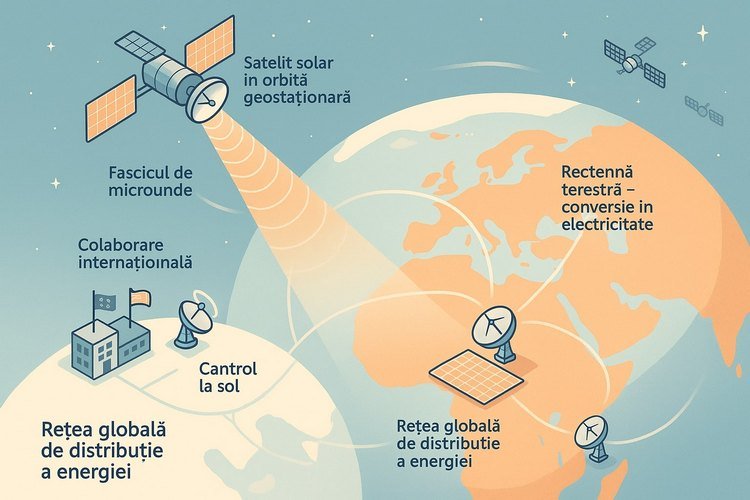 Space vs. Earth: Uninterrupted Collection, No Land Competition
Current Efforts and Perspectives
Globally, interest in SBSP is growing alongside efforts to achieve climate neutrality by 2050. Major space agencies and private companies are investing in the research of necessary technologies. NASA is assessing the potential costs and benefits of SBSP (analyzing demonstrator systems and reduced emissions), concluding that an operational system could become viable after 2050, as launch costs decrease. ESA has launched the SOLARIS program to mature key technologies: advanced photovoltaic cells, wireless power transmission, and robotic in-space assembly. In 2025, China unveiled a detailed plan for a gigantic orbital solar station (~1 km), demonstrating practical interest in the technology. Additionally, current tests—such as experiments in energy transmission between satellites and the ground (e.g., Star-Catcher)—are gradually validating the concept. It is estimated that with the advancement of reusable launches and orbital manufacturing, SBSP could become feasible in the coming decades, fulfilling the role of a new global energy source.
In parallel with government space agencies, the private sector is also playing an increasingly active role in the development of SBSP technologies. Companies like SpaceX, through its reusable Starship rocket, are helping reduce launch costs—crucial for transporting components into orbit. Northrop Grumman is exploring modular systems for building power-generating satellites, and Caltech, through its SSPP (Space Solar Power Project), successfully tested prototypes of ultra-light solar panels and wireless energy transmission in space in 2023. These initiatives show that the future of SBSP is also taking shape through public-private collaboration.
Near Future vs. Distant Future
SBSP (Space-Based Solar Power) technology has revolutionary potential, but its full implementation will unfold in stages. In the short term (by 2035), the main advances will be technological and demonstrative in nature:
- The launch of small-scale demonstrator satellites that will test energy collection and transmission under real conditions.
- Controlled microwave transmission experiments between orbits or between satellite and ground, such as the Star-Catcher project or the tests conducted by ESA and JAXA.
- Development of ultra-lightweight photovoltaic materials and autonomous assembly robots capable of building large structures in orbit.
- Cost reduction through reusable rockets (e.g., SpaceX Starship), which can transport SBSP satellite components more affordably.
In the long term (after 2040–2050), if current challenges are overcome, the following achievements are possible:
- Construction of large-scale orbital solar stations (with a capacity of over 1–2 GW), capable of powering entire cities.
- Integration of space-based energy into national power grids, ensuring a stable "base load" energy source that does not depend on weather conditions or the day/night cycle.
- Powering remote areas, military bases, or lunar colonies, where terrestrial energy solutions are not viable.
- Possible global commercialization of space-based energy, providing a large number of countries with access to a clean and continuous resource.
Thus, SBSP is not a utopia, but an ongoing process, whose maturity will depend on international collaboration, public/industrial investments, and accelerated technological innovation.
Moreover, SBSP has the potential to become a global strategic component. Space-collected energy, controlled by states or private consortia, could become a tool of geopolitical influence. Those who control SBSP infrastructure might also control access to a vital, continuous energy source,thereby influencing the economies of other countries. This possibility calls for the development of clear international regulations regarding access, sharing, and the security of SBSP orbital infrastructures.
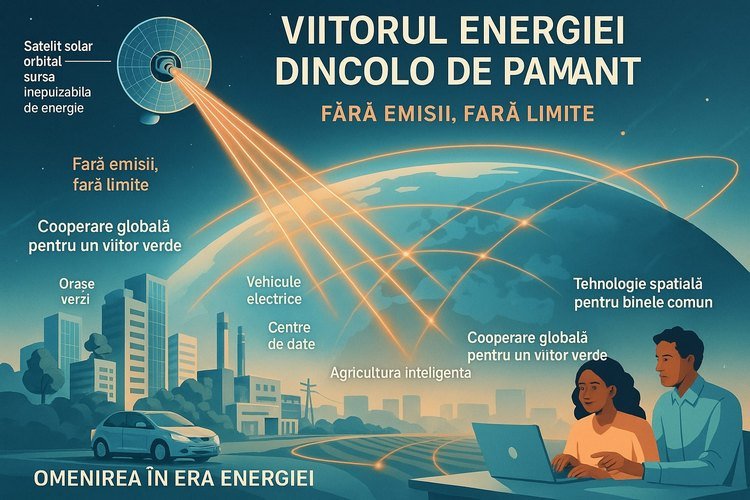 Global Perspectives: Solar satellites provide clean energy for cities, agriculture, transport, and technology – zero emissions, no limits.
Conclusions
Space-based solar power represents a spectacular and scientifically validated solution for the energy future. It provides access to a practically inexhaustible source (the Sun) and can deliver clean and continuous energy, contributing substantially to the replacement of fossil fuels. The technological and economic challenges are significant (high initial costs, complexity of space infrastructure), but current advances fuel optimism. Compared to the limited resources on Earth, SBSP could add essential capacity, complementing terrestrial generation systems.
As previously mentioned, the Sun sends an enormous amount of energy toward Earth — of which only a tiny fraction would be needed for SBSP. This highlights how strategic and efficient this technology could become, in the context of growing global energy demand and increasing climate pressures.
Overall, although full implementation will not happen immediately, current efforts and studies indicate that space-based solar power remains a viable and highly promising concept in the long term.
Glossary of Terms
- Solar energy: The energy emitted by the Sun in the form of electromagnetic radiation, meaning light and heat. This energy reaches the Earth and can be captured and converted into other usable forms of energy, especially electricity and thermal energy, through special technologies such as solar panels (which use photovoltaic cells) or solar thermal collectors.
It is a renewable, clean, and inexhaustible energy source on the human timescale, playing a key role in the transition toward a sustainable energy future. - Space-Based Solar Power (SBSP): An advanced technology that involves collecting solar energy directly from space using special satellites equipped with large solar panels. This energy is then transmitted to Earth in the form of microwaves or laser beams, where it is captured by receiving stations and converted into electricity. SBSP offers a major advantage because it can provide continuous, uninterrupted energy, unaffected by weather or the day-night cycle.
- Solar Satellites: Spacecraft in Earth's orbit specifically designed to capture solar energy. They are equipped with very large solar panels, which operate efficiently because, in space, sunlight is not blocked by clouds, the atmosphere, or Earth's rotation. These satellites transmit the collected energy to Earth using wireless technologies such as microwaves or laser beams.
- Geostationary Orbit: A circular trajectory located about 36,000 kilometers above Earth’s equator, where a satellite orbits at the same speed as Earth’s rotation. As a result, the satellite appears to “remain stationary” relative to a fixed point on the ground. This is an ideal position for communication or solar satellites, as it allows for continuous transmission of energy or information to the same location on Earth.
- Energy Conversion: The process by which one form of energy is transformed into another. For example, the Sun’s light energy is converted into electrical energy using photovoltaic cells, or into heat in the case of solar thermal collectors. Energy conversion is the foundation of all modern technologies that use energy sources to generate electricity, motion, or heat.
- Microwave Transmission: A technology that enables the transfer of energy in the form of high-frequency radio waves (called microwaves) from a satellite in space to a receiving station on Earth. This method is used in space-based solar power (SBSP) systems to deliver electricity collected from sunlight without the need for wires or cables.
- Rectenna: A special type of antenna located on Earth, designed to receive energy transmitted as microwaves from space and efficiently convert it into usable electricity. The name comes from the combination of the words “rectification” (the conversion of waves into direct current) and “antenna.”
- High-power laser: A highly concentrated and intense beam of light, artificially generated, which can be used as an alternative to microwaves to transmit solar energy from space to Earth. This type of laser is very precise and can deliver energy over long distances, but it requires advanced control and safety technologies.
- Laser beam: Highly concentrated beams of coherent light, meaning light of a single color (wavelength) that is precisely directed. The word "laser" comes from the acronym Light Amplification by Stimulated Emission of Radiation. Laser beams are extremely intense and are used in many fields: in medicine (surgery), industry (precision cutting), communications (data transmission via fiber optics), space technology, or even for energy transfer, as in SBSP (Space-Based Solar Power) systems. Due to their precision and intensity, laser beams can travel long distances without dispersing.
- Energy efficiency (efficiency rate): A percentage-based measure that indicates how much useful energy is obtained from a process compared to the total amount of energy initially available. A high efficiency means less energy is lost and the system operates effectively.
- Energy Storage: Represents all the methods by which energy produced at a certain moment (for example, from solar sources) is preserved for later use, when needed. The most common methods include electric batteries, thermal storage, or mechanical storage.
- Solar Intermittency: A specific issue of ground-based solar systems, which consists in the fact that solar energy is not available all the time, as it depends on weather conditions or the day-night cycle. In space, this problem does not occur, because satellites can capture sunlight continuously.
- Carbon Emissions: Gases, especially carbon dioxide (CO₂), that are released into the atmosphere as a result of burning fossil fuels such as coal, oil, or natural gas. These emissions contribute to the greenhouse effect and climate change.
- Decarbonization: The process of reducing carbon emissions, especially carbon dioxide, by transitioning to clean energy sources such as solar, wind, or hydroelectric power. It is essential for combating global warming and protecting the environment.
- Energy Sustainability: The capacity of an energy system to produce energy in a way that does not deplete the planet’s natural resources, does not pollute the environment, and can be sustained over the long term. Sustainability involves the use of renewable sources (such as solar or wind power) and the reduction of negative impacts on ecosystems.
- Fossil Fuels: Energy sources formed from the remains of plants and animals that lived millions of years ago. Examples include coal, oil, and natural gas. They are burned to produce energy, but release carbon dioxide (CO₂), which contributes to pollution and global warming. They are non-renewable, meaning they will eventually run out.
- Geopolitical Impact: The effects that a new technology, such as space-based solar power (SBSP), can have on relations between countries. This impact may include access to energy sources, the energy independence of certain states, the reduction of dependence on fossil fuels, or the emergence of international competition in the space and technology sectors.
- Demonstration Mission: A test carried out in real conditions, aimed at proving that a new technology, such as space-based solar power (SBSP), works correctly, is safe, and can be scaled up. Such missions are essential for the practical validation of theoretical or experimental concepts before they are implemented on a larger scale.
- Orbital Launcher: A rocket specifically designed to transport satellites, instruments, or components of space-based solar power systems beyond Earth’s atmosphere, placing them into orbit. It is a crucial part of modern space technology.
- Earth’s Atmosphere: The layer of gases that surrounds the Earth and supports life, but which can block or weaken part of the solar radiation. In SBSP systems, the fact that the panels are located beyond the atmosphere allows for more efficient and continuous sunlight capture.
- Earth’s Equator: An imaginary line that circles the Earth exactly halfway between the North Pole and the South Pole. It divides the planet into two equal halves: the Northern Hemisphere and the Southern Hemisphere. The equator marks the region on the globe where sunlight reaches most directly throughout the year, making the equatorial area very warm and giving it a stable climate.
This line plays an important role in science and technology: in astronomy, it serves as a reference point for the movement of celestial bodies; in geography, it helps with orientation and the measurement of latitude; and in satellite launches, it is useful because the Earth rotates fastest at the equator, providing an extra boost to satellites launched from this region. - NASA (National Aeronautics and Space Administration): The United States space agency, responsible for space exploration, scientific research, and the development of advanced technologies. NASA is involved in studying and testing systems for capturing solar energy from space, with applications for the planet’s future energy needs.
- ESA (European Space Agency): An international organization made up of several European countries that work together in the field of space exploration. ESA coordinates launches, scientific missions, satellites, and projects such as those related to space-based solar power (SBSP), for scientific and technological purposes.
- JAXA (Japan Aerospace Exploration Agency): Japan’s space agency, which develops its own technologies for space exploration. JAXA has dedicated projects for space-based solar power, including the launch of demonstration satellites that collect and transmit solar energy to Earth.
- SpaceX: A private American company founded by Elon Musk, specializing in the construction of reusable rockets and spacecraft. SpaceX plays an important role in space transportation and could support the launch and assembly of satellites for SBSP systems, contributing to the development of the necessary space infrastructure.
- Caltech (California Institute of Technology): A research university in the United States, globally recognized for its innovations in science and technology. Caltech is developing advanced experiments for capturing and transmitting solar energy from space, contributing to future SBSP systems.
- Northrop Grumman: An American aerospace and defense company that develops cutting-edge technologies, including satellite systems for capturing solar energy in space. It is involved in strategic projects that support the commercial application of SBSP.
- Solar Panel: A flat, usually rectangular device made up of multiple photovoltaic cells connected together. These cells are made from special materials (such as silicon) that can directly convert sunlight into electricity through a physical process called the photovoltaic effect.
Solar panels are used to generate electricity in an ecological and efficient way. They can be found on rooftops, in solar farms, on satellites, in space stations, or even on vehicles. They are essential for harnessing solar energy in everyday life. - Photovoltaic Cell: A small device made from special semiconductor materials—most commonly silicon—that has the ability to convert sunlight directly into electrical energy through a physical process called the photovoltaic effect. When light strikes the surface of the cell, it generates an electric current due to the movement of electrons released within the semiconductor material.
Photovoltaic cells are the basic units of solar panels—each panel contains dozens or hundreds of such interconnected cells that work together to produce electricity from sunlight. - Photovoltaic Effect: The photovoltaic effect is a physical phenomenon through which light—especially sunlight—striking a special material (such as silicon) causes the release of electrons, which are very small particles that carry electricity.
When these electrons begin to move, an electric current is generated.
This process is the foundation of how photovoltaic cells work—and, by extension, how solar panels operate.
Without the photovoltaic effect, we would not be able to convert light into electricity directly. - Silicon: A very common chemical element on Earth, symbol Si, found mainly in sand and rocks. It is a semiconductor, meaning it conducts electricity only under certain conditions – not always like a metal, but not never like an insulator. This property makes it ideal for use in photovoltaic cells, where it helps convert sunlight into electric current through the photovoltaic effect. Silicon is essential not only in solar energy, but also in the electronics industry, being used in the production of chips, transistors, and other electronic components.
- Energy: The ability to perform an action or produce a change. There are several forms of energy: electrical, thermal (heat), light, chemical, mechanical, nuclear. It is measured in joules (J) or kilowatt-hours (kWh).
- Electron: An extremely small particle, invisible to the naked eye, that is part of the structure of atoms—the building blocks of all matter in the universe. Electrons carry a negative electric charge and can move through certain materials (such as metals or silicon); this movement creates what we call electric current. In solar technologies, sunlight causes electrons in photovoltaic cell materials to be released and move, thus generating electricity. Without electrons, electricity would not exist.
- Electric current: The organized movement of electrons through a conductive material, such as a metal wire. Electric current is what makes light bulbs glow, devices operate, and energy flow through power grids. It is generated when electrons are set in motion by an energy source (such as a battery, a solar panel, or a power outlet). Without electric current, we could not power modern devices or transmit energy from one place to another.
- Matter: Anything that has mass and takes up space. Matter is made up of atoms, which in turn contain particles such as protons, neutrons, and electrons. Examples of matter include water, wood, air, our bodies, and the Earth itself. Energy, on the other hand, is not matter.
- Proton: A particle located in the center (nucleus) of an atom, carrying a positive electric charge. Protons, together with neutrons, give the atom its mass and stability. The number of protons in an atom determines what chemical element it is (for example, hydrogen has only one proton).
- Neutron: A particle in the nucleus of an atom, similar to a proton but without an electric charge (it is neutral). Neutrons help stabilize the nucleus and influence the properties of atoms, especially in nuclear reactions.
- Atom: The smallest unit of matter that retains the properties of a chemical element. It is like a "building block" from which everything around us is made—air, water, objects, plants, people. Each atom consists of a central nucleus (containing protons and neutrons) and electrons that move around it.
- Molecule: A group of two or more atoms bonded together. Molecules make up the substances we see or use every day—for example, a water molecule is made of two hydrogen atoms and one oxygen atom (H₂O). A molecule is a stable unit of matter that can have different properties than the individual atoms it is made from.
- Particle: A general scientific term used to describe a very small piece of matter, often invisible to the naked eye. Particles can be atoms, molecules, or even smaller units such as electrons, protons, and neutrons. Everything around us is made up of particles. In the context of solar energy, the term often refers to particles like electrons, which carry electricity and move when activated by light during the photovoltaic effect.
- Subatomic particles: The fundamental components of atoms. The most well-known are: electrons – with a negative charge; protons – with a positive charge; and neutrons – with no charge (neutral). These particles are much smaller than atoms and determine the physical and chemical properties of matter.
- Subatomic: Anything that occurs on a scale smaller than an atom. The term refers to particles, energies, or reactions that involve the internal structure of atoms.
- Nuclear energy: Energy released from the nucleus of atoms, either by splitting them (nuclear fission) or by fusing them together (nuclear fusion). This energy is extremely powerful and can be used to generate electricity in nuclear power plants or, in some cases, in weapons. It is a low-carbon energy source but involves significant risks and requires advanced technologies for safety and the management of radioactive waste.
- Nuclear fusion: A physical process in which two nuclei of very light atoms, such as hydrogen, merge to form a heavier nucleus, like helium. During this process, a huge amount of energy is released. This is the phenomenon that powers the Sun and stars, where temperatures and pressures are extremely high. Nuclear fusion is considered a clean and highly efficient source of energy, but it is still in the experimental stage on Earth, as it is very difficult to achieve under controlled conditions.
- Nuclear fission: A physical process in which the nucleus of a large atom, such as uranium, splits into two smaller nuclei, releasing a very large amount of energy and a few neutrons. This phenomenon is used in nuclear power plants to generate electricity. The process must be carefully controlled, as the released energy is extremely powerful and can trigger chain reactions. It is the main source of energy in today’s nuclear reactors.
- Nuclear reaction: A process that takes place inside the nucleus of an atom, in which the particles in the nucleus (protons and/or neutrons) are rearranged, combined, or split. These reactions can release very large amounts of energy. There are two main types: nuclear fission (breaking a large nucleus into two smaller ones) and nuclear fusion (combining two small nuclei into a larger one). These processes are used in nuclear power plants and in research for energy production.
- Nuclear: Refers to anything related to the nucleus of an atom. It is a term used to describe phenomena, technologies, or energies that involve changes in the atom’s nucleus. For example, nuclear energy is the energy obtained from nuclear reactions. The word commonly appears in expressions such as "nuclear power plant," "nuclear energy," or "nuclear reaction."
- Nuclear power plant: A specialized facility where electricity is generated using nuclear energy, primarily through the controlled fission of uranium or plutonium atoms. Inside the plant, the energy released by nuclear reactions heats water, producing steam that drives turbines to generate electricity. Nuclear power plants require strict safety measures to prevent radioactive accidents and to properly manage the resulting waste.
- Nuclear reactors: Complex installations where controlled nuclear reactions (especially fission) take place. The heat generated by splitting atoms (such as uranium) is used to produce steam, which drives turbines and generators to create electricity.
- Reactor: A general term used to describe a chamber or system where a chemical or nuclear reaction takes place. In the context of nuclear energy, "reactor" specifically refers to a "nuclear reactor."
- Uranium: A naturally occurring, heavy, and radioactive chemical element used in nuclear power plants to produce energy. When it undergoes fission (is split into smaller parts), it releases a large amount of heat, which can be converted into electricity. It is found in nature as ore.
- Plutonium: An artificial and radioactive chemical element, similar to uranium but rarer. It can be used in nuclear reactions to generate energy or in nuclear weapons. It must be handled with great care because it is highly toxic and radioactive.
- Ore: Rock extracted from the Earth that contains valuable metals or other substances. For example, uranium is naturally found in the form of ore and must be processed before it can be used as nuclear fuel.
- Radioactive waste: Residues or materials left over after using nuclear fuel (such as uranium or plutonium) in a reactor. These substances continue to emit harmful radiation for a long time and must be safely stored to protect the environment and human health.
- Radioactivity: The property of certain substances to emit radiation because their atomic nuclei spontaneously break down. This phenomenon can occur naturally (as in the case of uranium) or artificially (as in the case of plutonium). Radiation can affect living cells, which is why radioactive substances must be handled with care.
- Radioactive: An adjective that describes a substance that emits radiation (through radioactivity). For example, uranium is a radioactive material. These materials are used in nuclear power plants and in the medical field, but they can be dangerous without proper protection.
- Radiation: Energy that travels through waves or invisible particles, coming from a source such as the Sun, radioactive materials, or medical equipment. It can be harmless (like light or radio waves), but some types (called ionizing radiation) can affect the body if present in large amounts.
- Ionizing radiation: Types of radiation that have enough energy to remove electrons from atoms or molecules. This process is called ionization and can affect living cells. Examples of ionizing radiation include X-rays, gamma rays, and alpha or beta particles emitted by radioactive materials.
- Gamma radiation: Electromagnetic radiation with the highest energy and the shortest wavelengths. It is emitted during certain nuclear reactions or radioactive decays. Gamma rays can penetrate deeply into materials and bodies, making them dangerous to living cells if not properly shielded.
- Alpha particles (α): Helium nuclei made up of two protons and two neutrons. They are emitted by certain radioactive substances. Although they have high energy, they cannot penetrate human skin and are only dangerous if inhaled or ingested.
- Beta particles (β): Fast-moving electrons (or positrons) emitted during radioactive decay. They penetrate materials more than alpha particles but can be stopped by a thin layer of metal or plastic. They can affect cells if they enter the body.
- X-rays: A type of electromagnetic radiation invisible to the human eye, with very high energy. They are used in medicine to view the inside of the body (such as in X-ray imaging), but in high doses, they can be harmful, as they are a form of ionizing radiation.
- Ultraviolet (UV) rays: A type of electromagnetic radiation invisible to the human eye, with more energy than visible light. They are present in sunlight and can be beneficial (by stimulating vitamin D production), but also harmful (causing skin burns and damaging cell DNA).
- Rays: Very thin beams of light or other types of radiation, such as X-rays, gamma rays, or ultraviolet rays. In general, the term refers to energy that travels in a straight line from a source.
- Radio waves: A type of electromagnetic radiation with low energy and long wavelength. They are used for radio and TV broadcasts, wireless internet, and communication with satellites. They are non-ionizing and, in normal amounts, do not affect health.
- Electromagnetic radiation: A form of energy that travels through space as waves. It includes a wide range of wave types, such as visible light, X-rays, gamma rays, radio waves, and ultraviolet rays. All these types move at the speed of light and can carry energy without needing a material medium.
- Electromagnetic: A term that describes any phenomenon related to electricity and magnetism. For example, electromagnetic waves are oscillations of electric and magnetic fields that travel through space.
- Radioactive disintegration: Processes by which an unstable (radioactive) atom transforms into another atom, releasing energy in the form of radiation (alpha, beta, gamma). It is a natural phenomenon that occurs in radioactive elements such as uranium or plutonium.
- Positrons: Subatomic particles that are identical to electrons in mass, but have a positive electric charge. They are part of antimatter. When a positron meets an electron, they annihilate each other, releasing energy in the form of gamma radiation. Positrons are used in medicine, especially in PET scans (Positron Emission Tomography) for diagnostic imaging.
- Antiprotons: Subatomic particles that have the same mass as protons, but carry a negative electric charge (the opposite). They are part of antimatter. If an antiproton encounters a proton, they mutually destroy each other (annihilation), releasing a large amount of energy. Antiprotons are studied in particle physics to better understand the structure of the universe.
- Antimatter: A special type of matter made up of particles that are the "mirror" counterparts of those in normal matter. For example, antimatter contains positrons (electrons with a positive charge), antiprotons, and so on. When antimatter meets matter, both annihilate each other, releasing a tremendous amount of energy. It is studied in advanced physics research and cosmology.
- Temperature: A physical quantity that indicates how hot or cold an object or environment is. At the atomic level, temperature measures the speed at which particles move within a substance. Extremely high temperatures are required for fusion reactions, such as those that occur in stars.
- Pressure: The measure of force applied to a surface. In physics, it refers to the force with which gas particles push against the walls of the container they are in. In nuclear fusion reactions, extremely high pressures are required for atoms to fuse together.
- Carbon: A chemical element essential for life. All known forms of life contain carbon. It is found in many materials, including fossil fuels (coal, oil, gas), as well as in the Earth's atmosphere in the form of carbon dioxide (CO₂).
- Hydrogen: The lightest and most abundant element in the Universe. Each hydrogen atom has a single proton. It is used as fuel in nuclear fusion reactions (such as those in the Sun), where multiple hydrogen atoms fuse together to form helium, releasing energy.
- Helium: A noble gas, harmless and very light, that occurs naturally or is produced in nuclear fusion reactions. For example, in the Sun, helium is formed through the fusion of hydrogen atoms, releasing a large amount of energy.
- Generators: Devices that convert mechanical energy (usually from the movement of a turbine) into electrical energy. They are essential in power plants—whether solar, nuclear, wind, or hydro—to produce electricity for consumption.
- Joules (J): The unit of measurement for energy in the International System of Units (SI). It represents the amount of energy required to move an object with a force of one newton over a distance of one meter. For electricity, the kilowatt-hour (kWh) is also commonly used, which equals a much larger number of joules.
- Newton: The unit of measurement for force in the International System of Units (SI). One newton is the force required to accelerate a 1-kilogram object by 1 meter per second squared. The name comes from Isaac Newton, the physicist who formulated the law of gravitation.
- Mechanics (Mechanical Energy): The form of energy associated with the motion of an object or its position. For example, the energy of a spinning wheel or flowing water. In power plants, this energy is converted into electricity through generators.
- Organism: Any living being — from humans and animals to plants, bacteria, or fungi. An organism is made up of cells and performs vital functions such as respiration, growth, and reproduction.
- Cells: The basic structural units of all living beings. They are like the "building blocks" of life—each organism is made up of one or more cells. Cells perform essential functions, such as producing energy and repairing tissues.
- Living Cells: Active cells that function inside living organisms. These cells breathe, divide, respond to stimuli, and convert energy to sustain life. Radiation, toxins, or diseases can directly affect living cells, impacting the health of the organism.
- Substances: Materials or elements that have a defined chemical composition. They can be natural or artificial and may exist in solid, liquid, or gaseous states. Examples include water, oxygen, salt, plastic, and uranium.
- Toxic: Something dangerous to health if inhaled, ingested, or in contact with the skin. Toxic substances can damage organs, cause illnesses, or even death. Plutonium, for example, is extremely toxic.
- Artificial: Created by humans, not naturally occurring. For example, plutonium is an artificial element produced in laboratories or nuclear reactors, unlike uranium, which is found in nature.
- Vibrations: Rapid back-and-forth movements of an object or particles within a medium (air, water, solid). Vibrations are responsible for producing sound and can be transmitted as mechanical waves. For example, guitar strings vibrate and generate sounds.
- Oscillations: Repeated movements around an equilibrium position, like a pendulum or a swing moving back and forth. All vibrations are oscillations, but not all oscillations are necessarily rapid vibrations. Oscillations also occur in electrical circuits, electromagnetic waves, atoms, and more.
- Waves: Vibrations or oscillations that carry energy from one place to another without moving matter. They can be sound waves (through air), water waves, or electromagnetic waves (such as light or radio waves). Waves have characteristics like frequency, wavelength, and amplitude.
- Gravity: The natural force that attracts any object with mass toward other objects with mass. It is the reason we stay on Earth and why objects fall if not supported. It was scientifically described by Isaac Newton and, in more detail, by Albert Einstein in the theory of relativity.
- Outer Space: The region that begins beyond Earth's atmosphere, where there is no air, clouds, or weather, and where sunlight reaches uninterrupted. This space is ideal for the constant capture of solar energy by satellites, as it is not affected by the day-night cycle or Earth's weather conditions.
- Magnetism: A physical phenomenon produced by the movement of charged particles (such as electrons), which creates a magnetic field. This field can attract or repel certain materials, like iron. Magnetism is an essential part of electromagnetic waves and is used in generators, motors, magnets, and more.
Sources:
Recent research by NASA and ESA, as well as verified media sources, discuss the feasibility and challenges of space-based solar power. These provide data on the Sun’s energy potential, the advantages of continuous power flow, as well as the technical and security risks involved. Each of the above statements is supported by recent scientific studies and reports, properly cited.
Citations:
- Energia solară poate fi generată mai întâi în spațiul cosmic și apoi transmisă înapoi pe Pământ?
- ESA - FAQ: Frequently Asked Questions on Space-Based Solar Power
- SPACE POWER BEAMING – Air Force Research Laboratory
- Solar Arrays on the International Space Station - NASA
- New Study Updates NASA on Space-Based Solar Power - NASA
- China plănuiește să construiască un uriaș sistem solar în spațiu

What's Your Reaction?
 Like
0
Like
0
 Dislike
0
Dislike
0
 Love
0
Love
0
 Funny
0
Funny
0
 Angry
0
Angry
0
 Sad
0
Sad
0
 Wow
0
Wow
0